Wounded Knee
The Master Butchers Singing ClubWounded Knee is both a place in the novel’s account of the massacre and the enduring center of Step-and-a-Half’s traumatic memory. Roy Watzka tells Delphine how the girl and her Cree father came there with Lakota people seeking shelter; Step-and-a-Half’s later recollections show how the violence at the site shaped her lifelong wandering. The place returns not as a closed historical episode but as a force carried into family life, movement, and song.
The journey to Wounded Knee
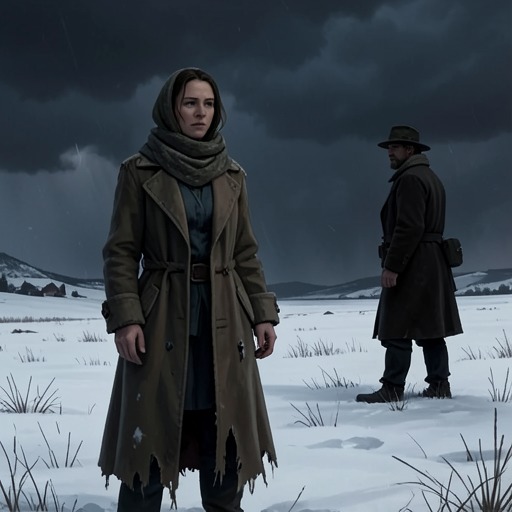
Roy’s account places the journey amid the Ghost Dance movement and the desperate conditions of the people who followed it. He describes Minneconjou Lakotas, whom he says others call Sioux, as hungry and freezing, with women, children, and a few exhausted warriors among them. Their chief, Big Foot, was gravely ill in a wagon drawn by the remains of horses. After the betrayal and death of Sitting Bull, the people were trying to survive and return home; their hope that dancing and singing might bring the dead back is presented alongside the more immediate needs of food and shelter.
A Cree father and his young daughter, Minnie, are among the travelers. The father has been sent by his people to learn whether the Ghost Dance can restore the dead, and he brings his youngest daughter with him. They join a group moving through the Badlands toward Chief Hump’s village. At Medicine Root Creek, the group is without food or shelter beyond the steep bluffs. At Porcupine Butte, Major Samuel M. Whitside of the Seventh Cavalry persuades them to proceed under a white flag of surrender to a military camp at Wounded Knee.
Roy’s telling emphasizes the gap between the promise of protection and the people’s actual vulnerability. The army has declared itself a shelter for Lakota people who approach, and Big Foot’s followers surrender their guns and establish camp where they are directed. They have almost nothing to eat: Minnie’s father shares their last piece of bannock, and a woman offers crumbs from a gingerbread figure she received at a church. The people accept the food and shelter they can find while relying on the assurance that they will be protected.
The massacre and Minnie’s escape
Roy recounts a brief interval of care before the violence begins. A woman with a baby shares the gingerbread and, the next morning, prepares a drink from a root for Minnie. A shot is fired outside as Minnie drinks. Roy presents that shot as the start of the attack: Minnie’s father runs out and is killed, and gunfire spreads through the camp. The woman takes Minnie toward the white flag, but soldiers fire into the camp, including with Hotchkiss guns. The woman is killed while nursing her child, and Minnie reaches her father in time to hear his last words.
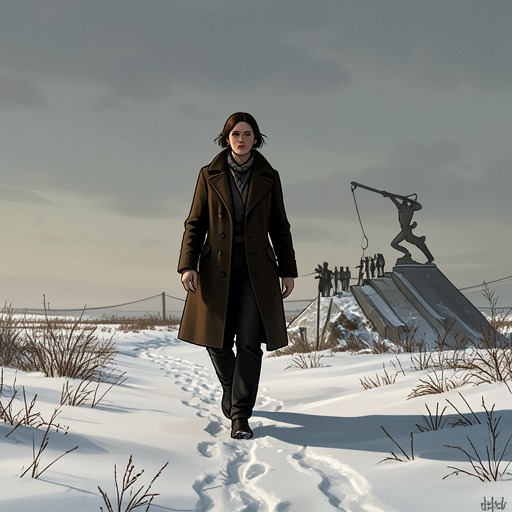
Minnie then moves through the scene and escapes down a ravine. Roy describes her seeing soldiers kill women and children and strip a dead girl of her shirt; the account makes clear that the scale of the violence exceeds the safety the white flag was meant to signify. Minnie gets beyond the camp, crosses a wire fence, and follows the tracks of other people fleeing through the snow. She continues until she reaches a mission run by a priest named Jutz. Her escape is not a return to safety in any lasting sense: the memories of the massacre accompany her beyond Wounded Knee.
Roy’s narration is a family disclosure as well as a historical account. He says Minnie became the woman who could not be tamed by him, and the story gives a reason for her need to keep moving. He tells Delphine that he cannot say more after recounting her flight, but the later narrative supplies the consequence: Minnie’s walking continues throughout her life. In this way, Wounded Knee enters the family story not only as a place of mass violence but as the origin of a pattern of movement and separation.
A place carried in memory
Step-and-a-Half’s later recollection gives that pattern its psychological meaning. She understands walking as the only way to outdistance what she remembers and what she cannot fully remember. The open spaces through which she travels offer a reprieve from human cruelty, even though weather and landscape can be harsh. Her movement is therefore neither simple restlessness nor a resolved escape: it is a repeated response to memories that remain active long after she has left the site.
Her memory returns to her father and to the words he spoke as they lay beneath gunfire, telling her to go home and say that it was over. The memory does not make the violence feel finished. She continues to hear the languages associated with her father and the Lakota people, as well as the silence left by those who died. The novel makes the remembered command to go home coexist with a life spent unable to stay in one place.
The massacre also survives in an object Step-and-a-Half keeps. She retains a fragment of a ghost shirt, a piece of yellowed muslin and fringe with a painted crow and moon. She rejects the idea that the Ghost Dance believers were foolish or deluded, understanding the shirt instead as a means of drawing comfort from the dead. Its significance rests in the closeness it preserves between the living and the dead, a closeness expressed through song rather than through any claim that the losses can be undone.
Historical violence and the novel’s structure
Wounded Knee’s importance comes partly from the way its story is passed between characters. Roy narrates the episode to Delphine as an account of Minnie’s childhood, while Step-and-a-Half’s later perspective shows the continuing burden of what happened. The shift from a spoken family story to the survivor’s enduring memories connects historical violence with the intimate acts of care, listening, and remembrance through which it enters later generations.
The novel also places this account in a broader history of control over people and movement. The Lakota group is directed to a military camp under a promise of shelter, then attacked there; Minnie survives by leaving the camp and following others’ tracks. Elsewhere in the book, German prisoners of war are marched in chains into a guarded camp in the woods, where restrictions govern their contact with civilians. These are distinct histories and circumstances, not equivalents, but their juxtaposition keeps confinement, guarded boundaries, and the power to determine who may move in view.
An acknowledgment notes that oral histories of the massacre say two people from the north, Cree or Ojibwe, died with Big Foot’s people, and that the author had long wondered about them. The novel’s inclusion of Minnie and her father gives narrative attention to that northern connection while identifying them as characters in a work of fiction. Wounded Knee thus anchors both a remembered family history and a larger act of imaginative witness: the site remains present through the survivor’s walking, the story she leaves behind, and the fragment of cloth she keeps.